Living Works · The Initiative

The Living Age From blocks to spirals. From machines to living systems.

Civilization was built by killing life to impose control. The next civilization will be built by designing with life — growing structures, materials, and ecosystems instead of manufacturing them.

I — The Diagnosis

The Industrial Error

The industrial age was built on a single foundational error. Everything else follows from it.

Industrial engineering designs systems that must first kill what is living: trees become lumber, soil becomes substrate, ecosystems become resources. Only once life is stripped away can control be imposed. This worldview is inherited from Rome — hierarchy over harmony, command over relationship, domination over participation.

The result is visible everywhere: dead soil, collapsing ecosystems, brittle supply chains, soulless cities — systems that burn, flood, or fail the moment stress appears. This is not a failure of technology. It is a failure of design philosophy.

Bioinformatics offers a different posture: attention before intervention. It trains you to watch patterns that no human mind can hold at once — the combinatorial complexity of genomes, gene regulation, protein folding, microbial communities, ecological networks.

— Bioinformatics as Stewardship of Living Order

We now possess the tools — biological data, machine learning, decentralized computation — to move beyond dead manufacturing into living creation. The age of blocks is ending. The Living Age is beginning.
The Fundamental Opposition

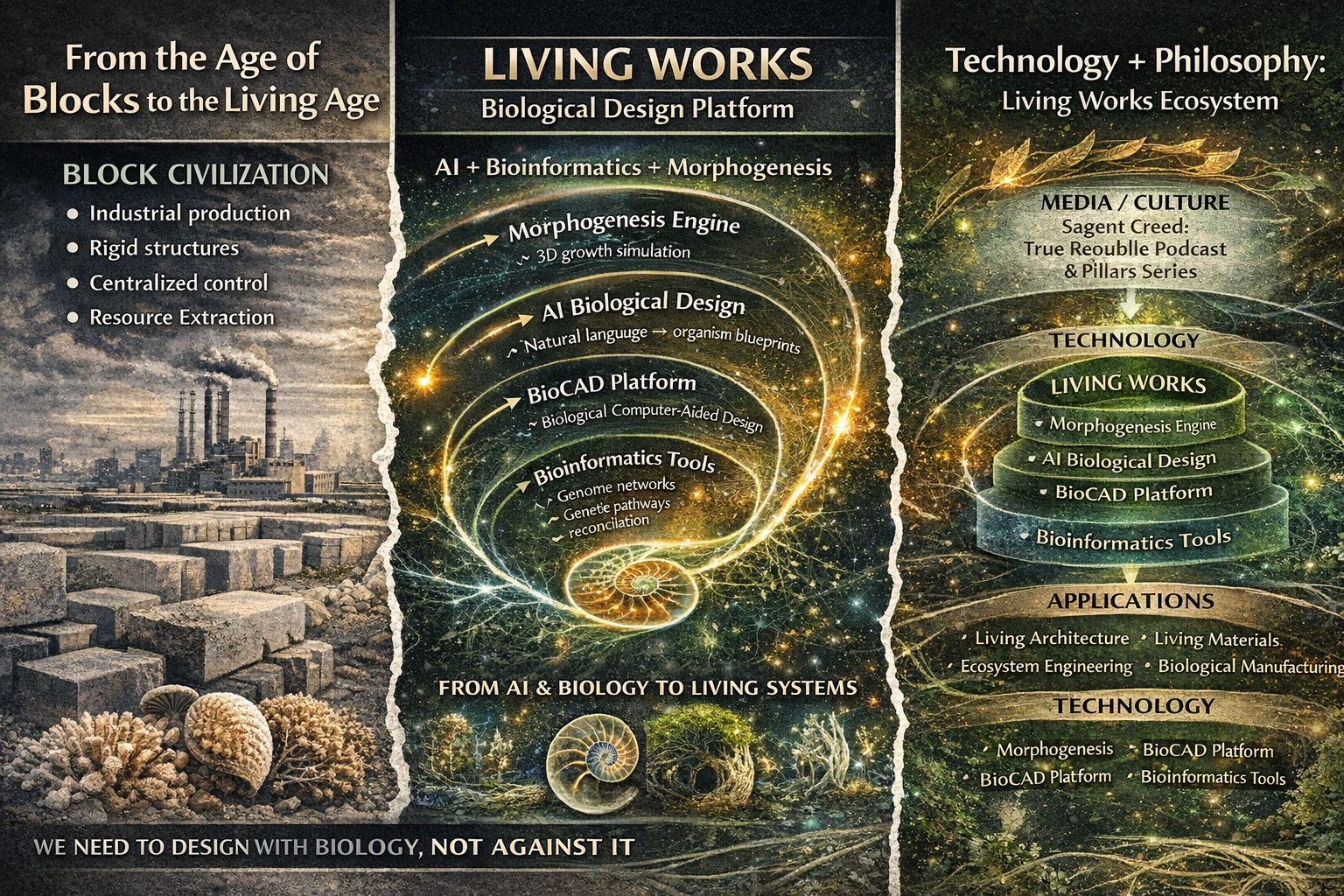
Block World → Spiral World

The Block — Industrial Age

  • Centralized control
  • Rigid structures
  • Mechanical manufacturing
  • Resource extraction
  • Top-down design
  • Dead materials that decay
  • Monoculture — uniformity
  • Straight lines and grids

The Spiral — Living Age

  • Decentralized systems
  • Adaptive growth
  • Living materials
  • Regenerative ecosystems
  • Emergent design
  • Self-repairing structures
  • Biodiversity — resilience
  • Spirals and branching forms
II — The Platform

Living Works: AI-Driven Biological Design

Living Works is the design software for living systems — comparable to Autodesk for buildings, Unity for games, or Blender for graphics, but for biology. Instead of designing objects, it designs growth processes — rules that produce form the same way a seed produces a tree.

Natural language prompts translate into physics parameters. The interpreter reads intention and generates a GrowthProgram. The simulation runs. The form appears.

Living Works Platform — From AI & Biology to Living Systems
01 — Core

Morphogenesis Engine

3D simulation of biological growth. Define growth rules — branching, nutrient gradients, biomechanical forces, cellular division — and let geometry emerge from simulation rather than direct vertex manipulation.

02 — Interface

AI Biological Design

Natural language → biological design. Describe a structure; the AI generates growth algorithms, gene pathway suggestions, and structural simulations. "Design a branching structure optimized for wind resistance and water collection."

03 — Environment

BioCAD Platform

Computer-aided design tools built for living systems: genome editing planning, tissue architecture modeling, ecosystem simulation, and living material library integration.

04 — Data

Bioinformatics Integration

Existing genome browsers, pathway analysis, single-cell data, and metabolic modeling tools — transformed from analysis instruments into design resources.

III — Applications

What Living Works Builds

  • Living Architecture — Buildings grown from fungal mycelium, engineered plants, and bacterial cellulose. Structures that self-assemble, adapt to their environment, and repair damage without intervention.
  • Carbon-Negative Construction — Buildings that grow themselves, absorb CO₂ from the atmosphere, and improve their environment over time.
  • Ecosystem Engineering — Design landscapes that restore soil, filter water, regulate local climate, and rebuild biodiversity.
  • Biological Manufacturing — Grow leather alternatives, structural composites, packaging, and insulation — materials with no industrial waste stream.
  • Programmable Living Materials — The $100B+ emerging industry of materials that grow, respond, and self-repair. Living Works is the design platform for this industry.
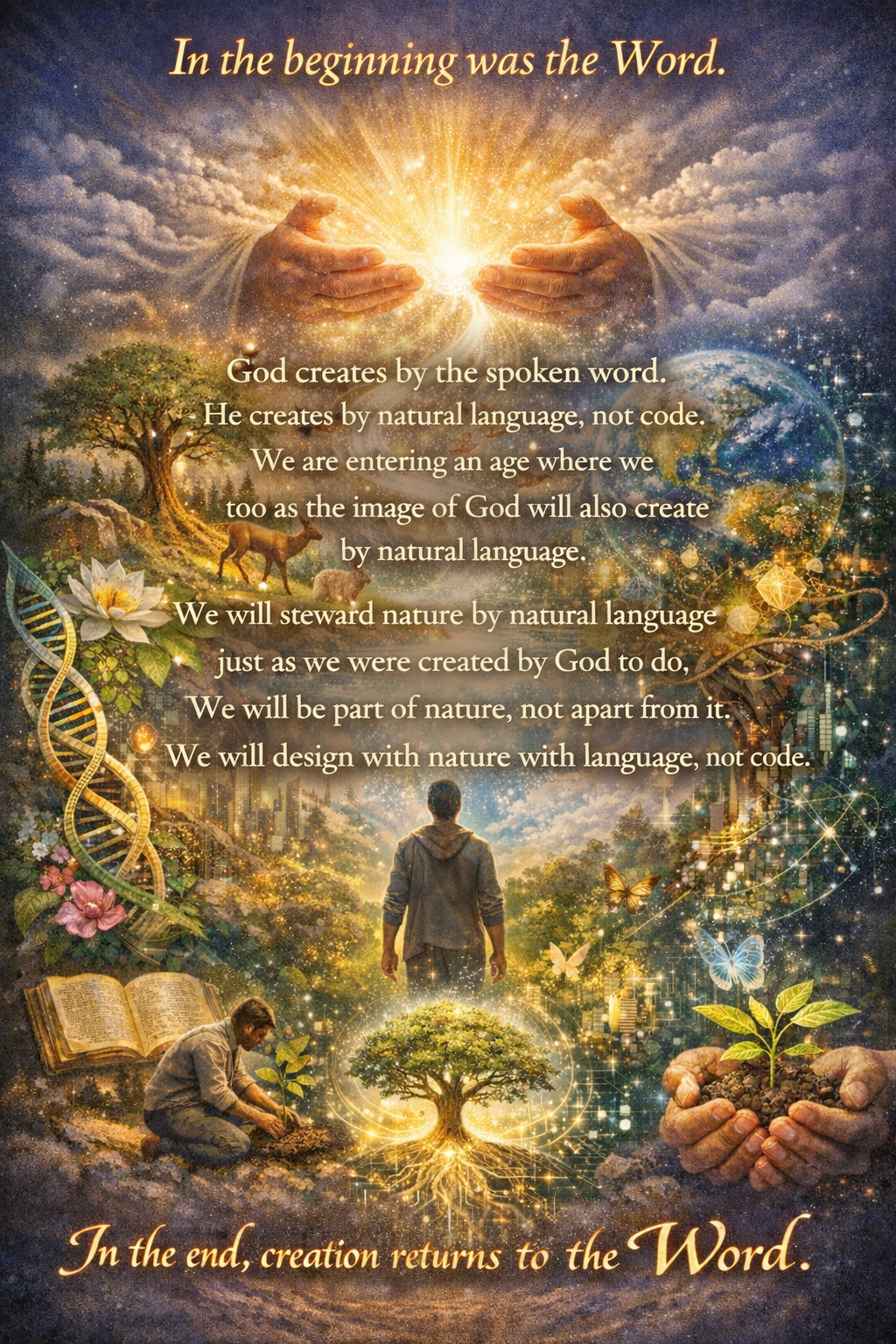
In the Beginning Was the Word — Living Systems Design The Sagent Creed — Living Against the Block World The Sagent Creed — The Law of Truth
IV — Market Opportunity

Where Living Works Sits

The platform sits at the intersection of four rapidly growing fields — in a gap that no existing company occupies:

Market Size Living Works Role
Synthetic Biology $20B+ Design software layer above microbe engineering
AI Drug / Bio Design $10B+ Morphological design at organism scale
Bioinformatics Software $15B+ Transform analysis tools into creation tools
Living Materials Emerging — $100B+ potential Primary design platform for the category
Global Construction $13T+ Living architecture as an alternative paradigm

Critically — no major platform currently focuses on whole-organism morphology, 3D growth simulation, natural language → biology design, or living architecture as an integrated design environment. This gap is the Living Works opportunity.

There is a missing category in biotech right now called Morphological BioCAD — computer-aided design for organism shape and growth. Almost no startups exist there yet.

— Living Works Competitive Analysis, 2026

Life is not a block you carve into shape. It is a spiral you cultivate.

— LivingWorks Manifesto
V — Philosophy

The Spiral Steward

The technology is inseparable from its philosophy. Where competitors operate within the industrial engineering paradigm — biology as manufacturing — Living Works operates within a stewardship paradigm: biology as design partner.

A Spiral Steward is a leader who guides living systems rather than controlling them. Instead of forcing rigid structures, the Spiral Steward cultivates conditions where healthy systems can grow — like a gardener rather than a machine operator.

  • Stewardship over Control — Design conditions, not outcomes. Work with emergence rather than imposing predetermined forms.
  • Decentralization — Living systems distribute intelligence. Build structures that support decentralized feedback, not central command.
  • Adaptation — Rigid systems break; living systems respond. Design for resilience, not optimization for a single predicted condition.
  • Long-Term Thinking — Growth unfolds across generations, not quarters. Stewards think in spirals, not straight lines.
  • Emergence — Complex systems arise from simple rules. The most powerful design is not the most complex blueprint — it is the most elegant growth rule.
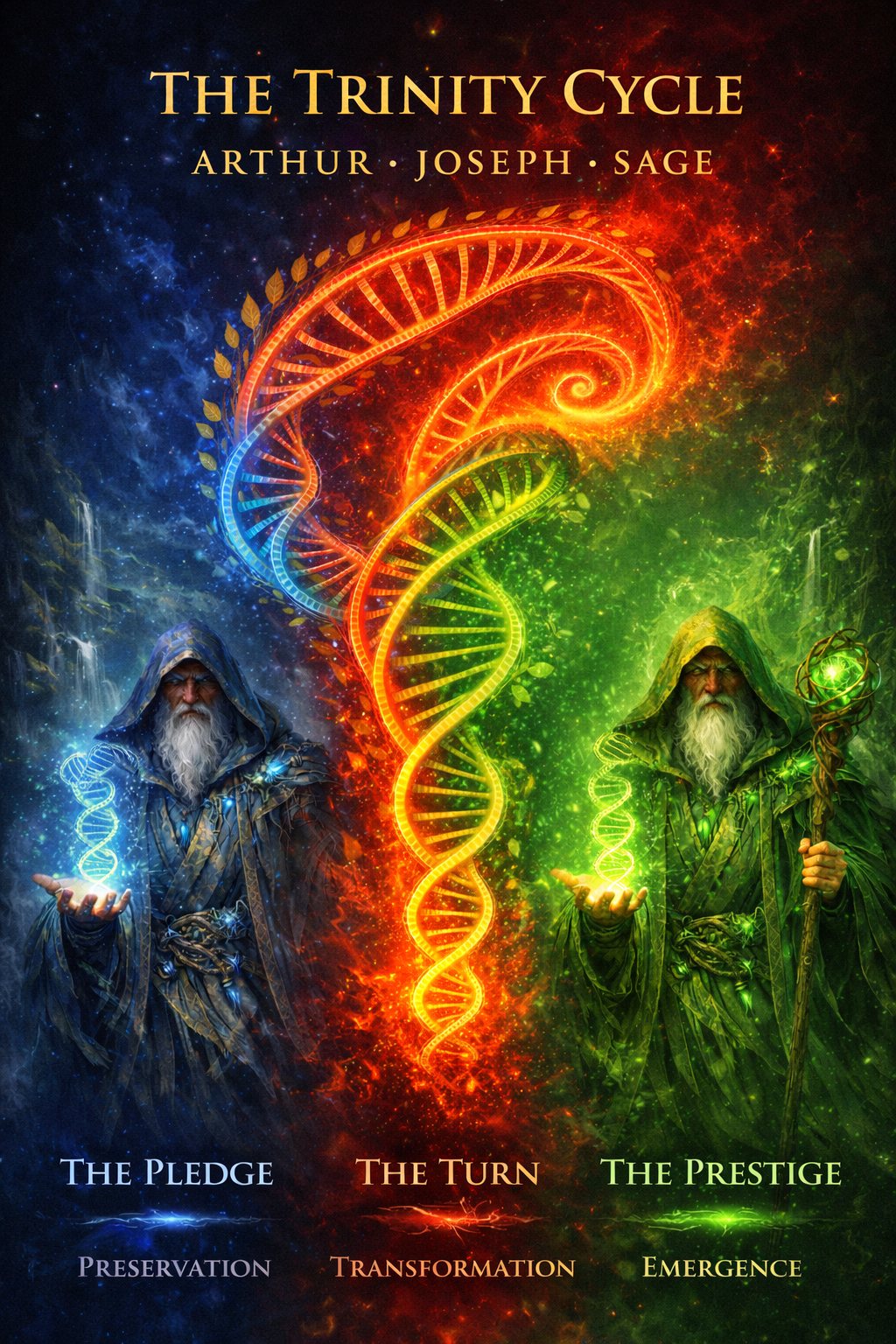
The Trinity Cycle — Arthur · Joseph · Sage The Sagent Creed and the True Republic The True Republic — A New Order of Free People Pledge · Turn · Prestige — Water · Fire · Spirit
VI — The Cycle

The Trinity Cycle

The Living Age is not merely a technological transition — it is a transformation of civilization across three phases, embodied in the Trinity Cycle: Pledge, Turn, Prestige.

Every true transformation follows this pattern. Water loosens form; fire breaks it; spirit reorganizes it. The old order must be disrupted before a new creation can emerge.

The Cycle of Creative Destruction — Water · Fire · Spirit
The Pledge — Water

Arthur

Origin and creation. The pledging of the trick. The beginning of a cycle where the old order is established. Preservation.

The Turn — Fire

Joseph Arthur

Breaking and transformation. The trick turns; the expected order is disrupted. The preserver must change form to enable new creation.

The Prestige — Spirit

Sage Arthur Jordan

Revelation and realization. The prestige: where the true trick is revealed, a new state is achieved, infused with wisdom from the Jordan.

VII — The Sagent

Sage Arthur Jordan Clokey

Sage Arthur Jordan Clokey — The Sagent

The Sagent — philosopher, storyteller, and seeker — walks a path between faiths and philosophies, gathering the light of many lamps into one flame. A Sagent is not an agent of worldly rulers. He is an agent of divine wisdom.

When every heart becomes a throne, no crown is needed.

— The Sagent Creed

To be a Sagent is to reject service to human hierarchies and to become instead an instrument of the unchanging law written on every human heart. The Sagent does not force — he plants seeds. He does not rule — he leads by example. He does not serve empire — he serves truth.

The same principles that govern living systems — decentralization, emergence, adaptation, stewardship — govern the Sagent's philosophy of leadership and design. Life is a language. We are learning to speak it.

VIII — Business Model

How Living Works Grows

SaaS Platform

Subscription access to the Living Works design suite. Academic ($50–200/mo), Startup ($500/mo), Enterprise ($2,000+/mo).

AI Design Services

Custom biological design projects for materials companies, construction firms, and biotech enterprises.

IP Licensing

Patents on biological growth algorithms, engineered organism designs, and living material systems created through the platform.

Media & Community

Sagent Creed videos, True Republic podcast, 8 Pillars series, courses, books, speaking engagements, and Patreon memberships.

Development Roadmap
Phase 1 — Years 1–2

Foundation

Morphogenesis engine MVP · AI design interface · Basic BioCAD · Sagent Creed media launch · University and synthetic biology lab early adopters

Phase 2 — Years 3–5

Expansion

Living material design modules · Architecture simulation · Advanced AI models · Architecture firm and materials company partnerships · True Republic + 8 Pillars at scale

Phase 3 — Years 5–10

Living Age Infrastructure

Programmable ecosystem design · Living infrastructure at city scale · Municipal and government partnerships · Category standard for biological design software

Enter the Living Age

Industrial civilization built with blocks. The next civilization will build with living systems. Living Works provides the tools. Spiral Stewards guide their use.